
From Notation to Execution: Mastering the BPMN 2.0 Architecture
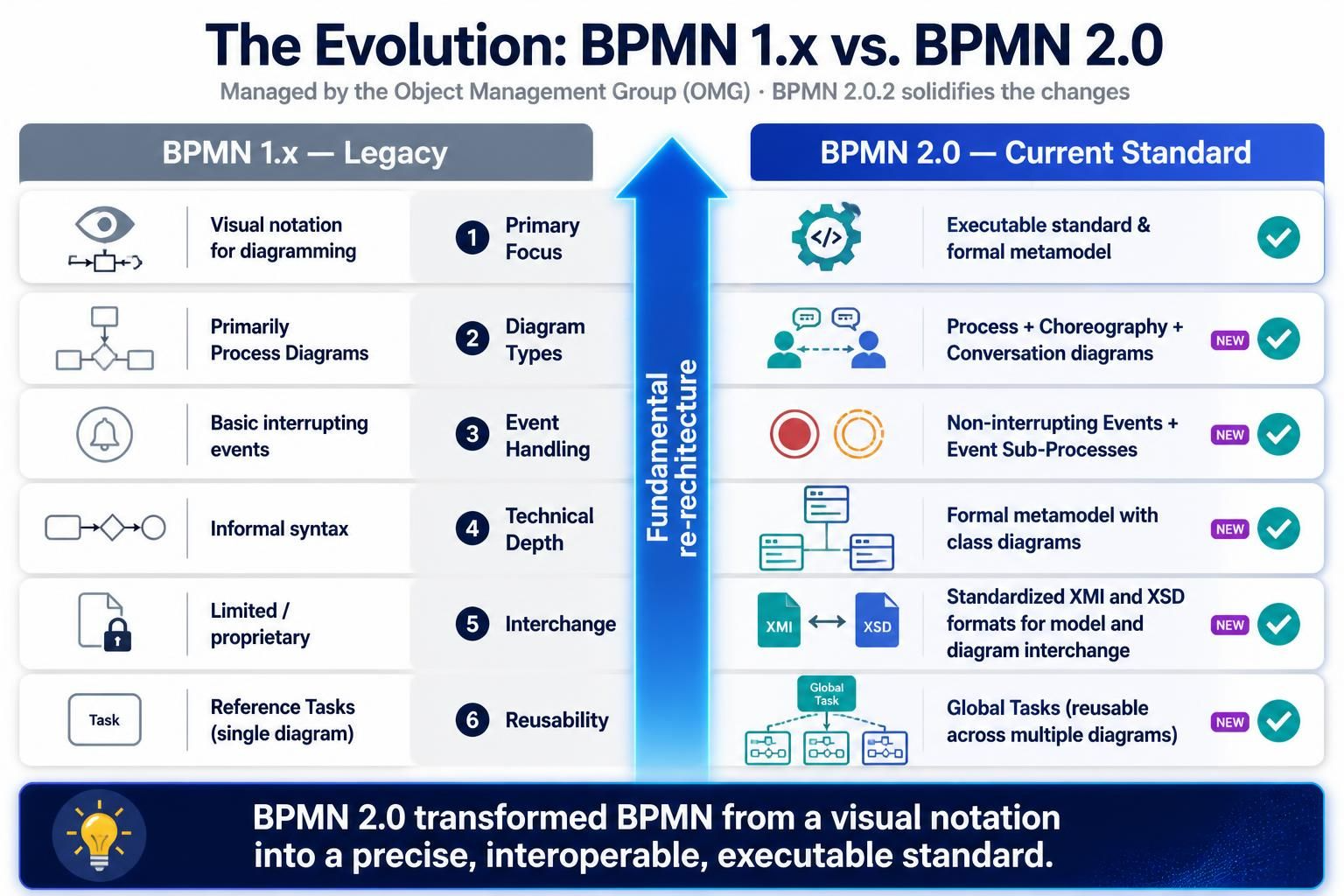
Business Process Model and Notation (BPMN) has long been the industry standard for visualizing workflows. However, the leap from BPMN 1.x to BPMN 2.0 represents a paradigm shift that fundamentally changed how we design, document, and execute business processes. This tutorial explores the technical depth of the BPMN 2.0 metamodel, moving beyond simple diagramming to the realm of executable standards.
The Fundamental Re-architecture
The transition from the legacy BPMN 1.x specifications to the current BPMN 2.0 (specifically version 2.0.2) is described as a “fundamental re-architecture.” While BPMN 1.x was primarily a visual notation for humans to understand processes, BPMN 2.0 was designed to be an executable standard with a formal metamodel.
This architectural shift allows organizations to move from static documentation to dynamic execution. In the legacy model, a diagram was a picture of a process. In the 2.0 model, the diagram is a blueprint that can be parsed by software engines to run the actual business logic.
1. Primary Focus: Visual vs. Executable
The most critical difference lies in the primary focus of the standard:
- BPMN 1.x (Legacy): Focused on Visual Notation. It provided a way to draw diagrams that stakeholders could understand, but the underlying syntax was often informal. The meaning of the diagram relied heavily on the reader’s interpretation.
- BPMN 2.0 (Current): Focused on being an Executable Standard. It utilizes a formal metamodel, meaning every element has a precise definition and behavior that a computer can interpret.
Diagram Types and Scope
One of the most visible expansions in BPMN 2.0 is the introduction of new diagram types that facilitate complex collaboration modeling.
From Process to Choreography
In the legacy version, the standard was limited primarily to Process Diagrams (internal workflows). BPMN 2.0 added:
- Choreography Diagrams: These allow you to model the interaction between multiple participants (organizations or systems) without defining a specific orchestration engine. It answers the question: “How do these parties exchange messages?”
- Conversation Diagrams: These provide a high-level view of the communication exchange, useful for summarizing complex interactions.
Technical Depth: The Metamodel
BPMN 2.0 introduces a Formal Metamodel supported by class diagrams. This technical depth allows for:
- Formal definitions of elements (Tasks, Events, Gateways).
- Interchange between tools using standardized formats like XMI (XML Metadata Interchange) and XSD (XML Schema Definition).
Advanced Event Handling
One of the most powerful features introduced in BPMN 2.0 is the granular control over events. The legacy standard offered basic interrupting events, but the 2.0 standard expanded this significantly.
Non-Interrupting Events
Non-interrupting events allow a process to continue running concurrently while an event occurs. For example, a “Timer” event can trigger a notification email without stopping the main order processing flow. This enables complex, multi-threaded logic that was difficult to represent in 1.x.
Event Sub-Processes
BPMN 2.0 formalized the concept of Event Sub-Processes. This allows you to group a set of activities that are triggered by a specific event. These can be:
- Interrupting: Stops the main process flow.
- Non-Interrupting: Runs in the background parallel to the main flow.
Reusability: Global Tasks
In the legacy standard, if you wanted to reuse a complex process logic, you often had to create a “Reference Task” which was typically limited to a single diagram or required manual copying.
BPMN 2.0 introduced Global Tasks. These are reusable definitions that can be referenced across multiple diagrams. If you update the definition of a Global Task, the change propagates to every diagram where it is used, ensuring consistency and reducing maintenance overhead.
Summary of Evolution
The evolution of BPMN 2.0 transforms the standard from a visual language into a precise, interoperable, and executable standard. By adopting the formal metamodel and advanced features like Choreography and Global Tasks, organizations can ensure their business processes are not just documented, but are ready for automation and execution.