
Mastering Inheritance in UML: Best Practices and Design Guidelines
In the realm of system architecture and software design, the Unified Modeling Language (UML) serves as the universal blueprint for developers. Among the various diagram types, the Class Diagram is paramount for visualizing the static structure of a system. Within this diagram, Inheritance (also known as Generalization) is one of the most powerful yet frequently misused relationships. It allows for the creation of hierarchical structures that promote code reusability, polymorphism, and maintainability.
This guide explores the industry best practices for modeling inheritance, ensuring your architectural diagrams are not only visually accurate but also semantically robust.
Understanding the Semantics of Generalization
At its core, inheritance represents a taxonomic relationship between a more general classifier and a more specific classifier. It is fundamentally an “is-a” relationship. If you model a relationship where the specific classifier does not strictly inherit the features of the general classifier, you are likely modeling a “has-a” (composition/aggregation) or a dependency relationship incorrectly.
Key semantic rules include:
- Indirect Instances: Each instance of the specific classifier (subclass) is also an indirect instance of the general classifier (superclass). For example, a
Circleis aShape. - Feature Inheritance: The specific classifier inherits the attributes and operations defined in the more general classifier.
- Specialization: Subclasses are specializations of the superclass, often adding new attributes or overriding existing behaviors to suit specific needs.
Best Practice: Always verify the “is-a” test before drawing an inheritance line. Ask yourself: “Is a [Subclass] a [Superclass]?” If the answer is no, do not use inheritance.
Visual Notation Standards
Visual consistency is critical for effective communication among stakeholders. In UML Class Diagrams, the representation of inheritance is standardized to ensure clarity across different modeling tools and teams.
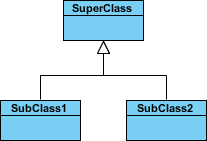
The standard notation consists of:
- A solid line connecting the two classes.
- A hollow arrowhead at the end of the line.
- Directionality: The arrowhead must point from the child element (subclass) to the parent element (superclass).
Note on Variations: While some tools or legacy diagrams may render this connector slightly differently (e.g., varying line thickness or arrow styles), the semantic meaning remains identical. However, for professional documentation, adhering to the standard solid line with a hollow arrow is the recommended approach to avoid confusion.
Modeling Abstract Classes and Interfaces
Inheritance is not limited to concrete implementation details; it is equally vital for defining abstract concepts. When a class serves as a template for other classes but should never be instantiated on its own, it is marked as an Abstract Class.
Visual guidelines for abstract classes include:
- The class name must be displayed in italics.
- The class is often denoted with a stereotype like <
> in some modeling standards, though italics are the universal visual cue.
Consider a hierarchy of Shapes. Shape is abstract because you cannot create a generic shape without defining its specific geometry. SubClass1 and SubClass2 (e.g., Circle and Rectangle) are the concrete specializations derived from Shape.
Design Patterns and Implementation Guidelines
Translating UML diagrams into code requires adherence to specific design patterns to maximize the benefits of inheritance.
1. The Liskov Substitution Principle (LSP)
When you have an instance of a subclass, it should be replaceable with an instance of its superclass without breaking the application logic. If a subclass changes the behavior of a method inherited from the superclass in a way that surprises the caller, you have violated LSP.
2. Avoiding Deep Inheritance Hierarchies
While deep hierarchies can seem organized, they often lead to the “Fragile Base Class” problem. Changes in a superclass can ripple unpredictably through dozens of subclasses. Aim for a hierarchy depth of 3 to 4 levels maximum.
3. Favoring Composition over Inheritance
Do not use inheritance to share code if the relationship is not a strict “is-a” relationship. If a Car has an Engine, it should not inherit from Engine. Instead, the Car class should hold a reference to an Engine object. This is a common pitfall in early software design.
Common Pitfalls and Anti-Patterns
Even experienced architects fall into traps when modeling inheritance. Be vigilant against these common anti-patterns:
- The “God Class” Hierarchy: Creating a massive, monolithic superclass that contains logic for every possible scenario. This makes the system rigid and difficult to extend.
- Mixing Concerns: Using a single inheritance chain to model unrelated concepts. For example, having
Employeeinherit fromUserandVehiclesimultaneously (if not using multiple interfaces) creates semantic confusion. - Abstract Base Classes with Concrete Behavior: While abstract classes can have concrete methods, they should primarily define the interface. If an abstract class contains too much implementation logic, consider extracting that logic into a separate utility class or using composition.
- Incorrect Arrow Direction: One of the most frequent errors in tools like Visual Paradigm is drawing the arrow from the parent to the child. Remember: the arrow points to the parent, symbolizing the “is-a” flow upwards to the general concept.
Conclusion
Properly modeling inheritance is a cornerstone of robust system design. By adhering to UML standards, respecting the semantic meaning of the “is-a” relationship, and following the Liskov Substitution Principle, you can create architectures that are scalable, maintainable, and clear.
Remember that a diagram is a living document. As your system evolves, revisit your inheritance hierarchies to ensure they still reflect the current domain logic. Avoid deep nesting, prefer composition where appropriate, and always use italics to clearly distinguish abstract concepts from concrete implementations.